
Since March 2020 I have only given talks online. These work well and many beekeepers welcome the opportunity to learn something new without having to drive halfway across the county on a cold, wet, winter night.
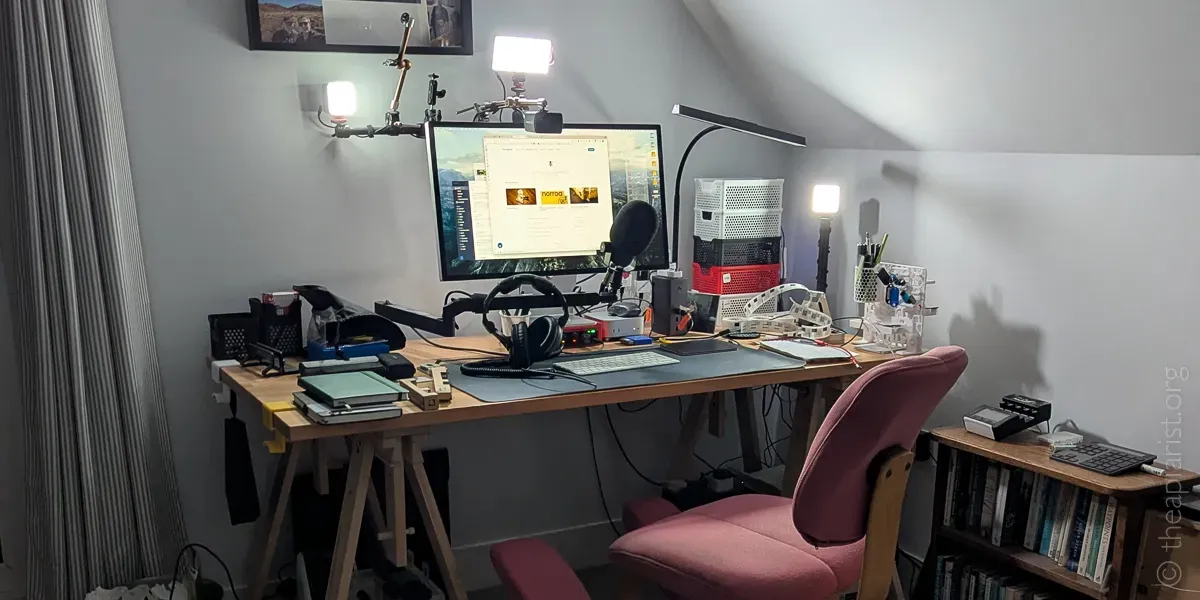
I have a fast fibre connection and high quality video and audio setup … it's not the same as being in the same room, but it is pretty good.
I get many invitations to talk 'in person'. Although it's always flattering to be invited, the distances and time involved are neither practical nor environmentally sustainable. I live in a beautiful part of the country and would prefer to be here than in the car or an airport.
Zoom, Teams and GoToMeeting
Of the three, if there's a choice, use Zoom.
I've used Zoom and Teams hundreds of times and Zoom is consistently easier to use by the host, the audience, and the speaker. The only problems I have encountered with Zoom were one association that struggled to hook up a room speaker system to their laptop (i.e. not a Zoom problem), and when associations forget to send me the meeting link before the talk (remember, I'm not on your association mailing list!).
I've recently used Google Meet and it worked well. I think there are preferential rates for charities and educational users. The most basic version does not allow recording.
Most talks last ~65 minutes, and I can therefore include a refreshment break … it gives my voice a break and allows the audience to recharge their glasses.
Unlike 'in person' talks, you have to provide your own tea and biscuits (or wine).
Questions and answers
Questions and answers are an important and enjoyable part of the evening (after all, I've heard the talk before, but I've not heard your questions). For small groups, no more than ~25, questions can be handled by the audience unmuting and asking directly. The host usually needs to coordinate this … a free for all favours the confident or loudest (who often aren't those with the most interesting question).
It helps if the audience are familiar with the 'raising the hand' Zoom gesture, which makes things a lot easier.
For larger groups — and I've talked to groups of over 350 — questions are best submitted via the 'chat' function. The host then reads questions out, ideally following a bit of sanity checking, ranking them by popularity and weeding out duplicates.
I'm happy to have a short pre-meeting with the host to discuss arrangements for the evening if needed. Typically, this can be done on the night of the talk.
Mixed 'hall' and online meetings
These are becoming increasingly popular. The association meets in a hall, and others join online. With a reasonable audiovisual setup in the hall this format works well. It requires a little more work by the MC to make the Q&A work smoothly, but it's worth the effort (and ensures everyone attending can have a good chat afterwards).