💡
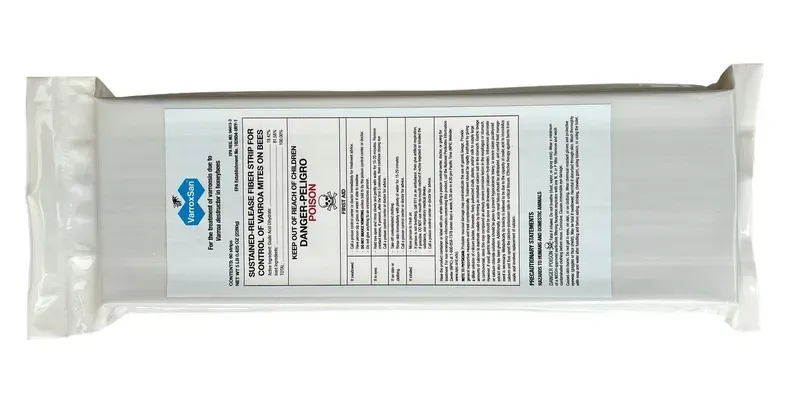
This table accompanies a post on the use of slow-release oxalic acid strips to control amitraz/Apivar-resistant Varroa mite levels overwinter. See the original post for further details.
Primary data — the first three columns — extracted from Vita-Europe's published data on VarroxSan field-testing (PDF). The approximate latitude and temperature range for the test dates was determined by Claude. See the notes in the footer for further details.
| Study Name | Testing Facility | Test Date | Approx. Latitude | Approx. Temperature Range (°C) |
|---|---|---|---|---|
| Control of Varroa destructor in colonies of bees (Apis mellifera) with Oxalic acid in cardboard strips (VarroxSan™) | INIA La Estanzuela Experimental Station, Colonia, Uruguay | May – August 2017 | ~34.3°S | ~9 to 17°C |
| VarroxSan™ Efficacy Study | Agricultural Experiment Station of INTA, Concordia, Argentina | May – June 2021 | ~31.4°S | ~9 to 20°C |
| Efficacy trial of VarroxSan for control of Varroa mites in honey bee colonies in Northwestern United States | Moscow, Idaho, USA | September – November 2021 | ~46.7°N | ~-1 to 23°C |
| Field tests to assess the efficacy of VarroxSan™ against varroa infestation and its safety on honeybees | Chalkidiki, Greece | November – March 2022 | ~40.3°N | ~1 to 15°C |
| Honey and beeswax quality after VarroxSan™ application in honey bee colonies during nectar flow | INIA La Estanzuela, Colonia, Uruguay | January – March 2021 | ~34.3°S | ~18 to 28°C |
| Evaluation of multiple formulations of long-term Oxalic acid applications for the control of Varroa destructor in honeybee (Apis mellifera) hives | Michigan State University, Lansing, Michigan, USA | June – August 2023 | ~42.7°N | ~14 to 26°C |
| Report on Efficacy Testing of VarroxSan™ in Transported Packages 2025 | Pullman, WA, USA (inferred — WSU Honey Bees & Pollinators Program; not explicitly labeled) | April 2025 (inferred from experiment/transport dates) | ~46.7°N | ~2 to 14°C |
| Fall and summer seasonal evaluation of a stabilized oxalic acid formulation (VarroxSan™) for control of varroa mites (Varroa destructor): efficacy, toxicity and residue | Pullman, WA, USA (inferred — WSU M.S. thesis; not explicitly labeled) | Fall & summer seasons; year not stated (thesis dated May 2024) | ~46.7°N | Summer: ~11 to 29°C; Fall: ~0 to 24°C |
Notes: The last two rows lack the explicit "Testing facility"/"Test date" labels used in the other six studies — facility and date are inferred from surrounding narrative text (Pullman, WA references, experiment dates). Latitudes are approximate city/region-level values. Temperature ranges are approximate long-term climate averages (typical monthly min/max) for the named location during the stated test period, not measured on-site weather data from the trials themselves.